Gravel Driveways

Driveway replacement and conversion to gravel

Replace old tarmac, concrete, paving or lawn with a permeable gravel drive. Break-out, waste removal and new base explained, with typical UK prices.

In short: Driveway replacement and conversion means breaking out an old tarmac, concrete or paved drive, or digging out a lawn, and rebuilding it as a permeable gravel driveway. It suits owners with a cracked or failing drive, or a front garden they want to park on. Expect roughly £50 to £110 per square metre in the UK, as break-out and waste add to new-build costs.

Get a free quote

Fixed price, no obligation. We aim to reply the same day.

By sending this form you agree to be contacted about your enquiry. See our privacy policy.

Driveway replacement and conversion to gravel

Replacing an old drive with gravel is one of the most cost-effective upgrades for a front garden. Cracked concrete, crumbling tarmac and sunken paving can be broken out with a breaker or mini digger and removed by grab lorry or skip. Sometimes the old base underneath is sound enough to reuse once it has been checked, re-levelled and topped up, which can reduce the cost.

Converting a lawn or planted front garden into parking is also common. Because gravel is permeable, a new or replacement front drive in England does not normally need planning permission whatever its size, although flats, listed buildings and areas with an Article 4 Direction are exceptions. If you will drive across a pavement or verge, a dropped kerb needs separate approval from the highway authority.

What is included

  • Breaking out old concrete, tarmac, block paving or slabs
  • Lifting turf, plants and topsoil for lawn conversions
  • Loading and removal of hardcore and soil through proper waste routes
  • Assessment of the old base for reuse or replacement
  • New or rebuilt compacted sub-base to suit the ground
  • Edging, membrane and gravel laid to the agreed design
  • Adjustment of manhole covers and gullies to the new level

Who it is for

  • Cracked, sunken or potholed concrete and tarmac drives
  • Loose or weed-ridden block paving that is not worth relaying
  • Front lawns being converted into off-street parking
  • Homes where an impermeable drive floods or drains onto the road
  • Buyers smartening up a property before sale or letting

How much does it cost?

As a guide, replacing an old drive with gravel in the UK usually costs around £50 to £110 per square metre, with thick reinforced concrete and large volumes of waste at the higher end. Lawn conversions are often cheaper as there is less to break out. See our full cost guide.
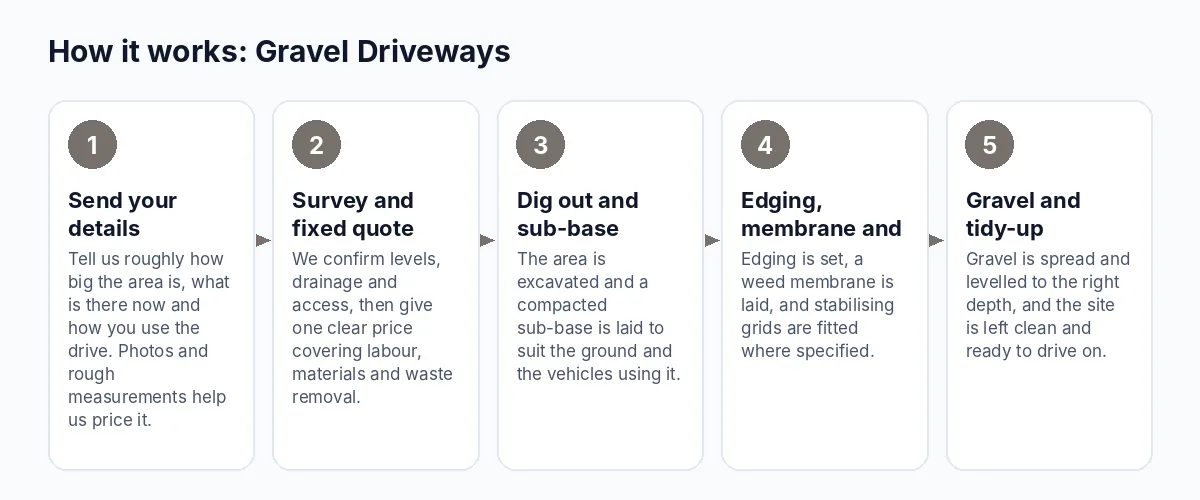
How it works

How driveway replacement and conversion to gravel works, step by step
  1. Assess the old drive

    Thickness of concrete or tarmac, the state of the base, drainage and nearby services are checked before quoting.

  2. Break out and clear

    The old surface is broken up and removed, and the ground dug to the depth needed for the new build-up.

  3. Rebuild the base

    The sub-base is reused, topped up or rebuilt and compacted, with edging and any drainage added.

  4. Lay the gravel

    Membrane, grids if specified, and gravel are laid, and covers and edges finished to level.

Driveway replacement and conversion to gravel: FAQs

Can gravel be laid over old concrete or tarmac?

It is possible to lay gravel over a sound, level hard surface, but it is rarely a good idea for a driveway. Water cannot drain through, so it pools under the gravel, the stones slide on the smooth surface, and the level often ends up too close to the damp-proof course. Breaking the old surface out, or at least breaking it up so it drains, gives a much better result.

Is my old driveway base reusable?

Sometimes. If the old concrete or paving sat on a well-compacted layer of hardcore that has not sunk or mixed with soil, it can often be re-levelled, topped up with new crushed stone and compacted again. If it is thin, contaminated with clay or has failed in places, it is better to dig out and rebuild. An installer should look before deciding.

What happens to the old concrete and tarmac?

It should be removed by a licensed waste carrier and taken to a site that crushes and recycles it. Concrete and stone are commonly recycled into new aggregates. Old tarmac should be handled as its own waste stream, because older tarmac and asphalt can contain coal tar, which is classed as hazardous. Ask your installer how the waste will be disposed of.

Do I need permission to turn my front lawn into a drive?

In England you do not normally need planning permission for a permeable gravel drive in a front garden, but a dropped kerb needs approval from the local highway authority if you cross a pavement or verge. Flats, listed buildings and homes in areas with an Article 4 Direction may need planning permission, and the rules differ in Wales, Scotland and Northern Ireland.

Get a quote for driveway replacement and conversion to gravel

Send a few details and get one clear, fixed price, usually the same day.

Get a quote

Last updated 6 November 2026