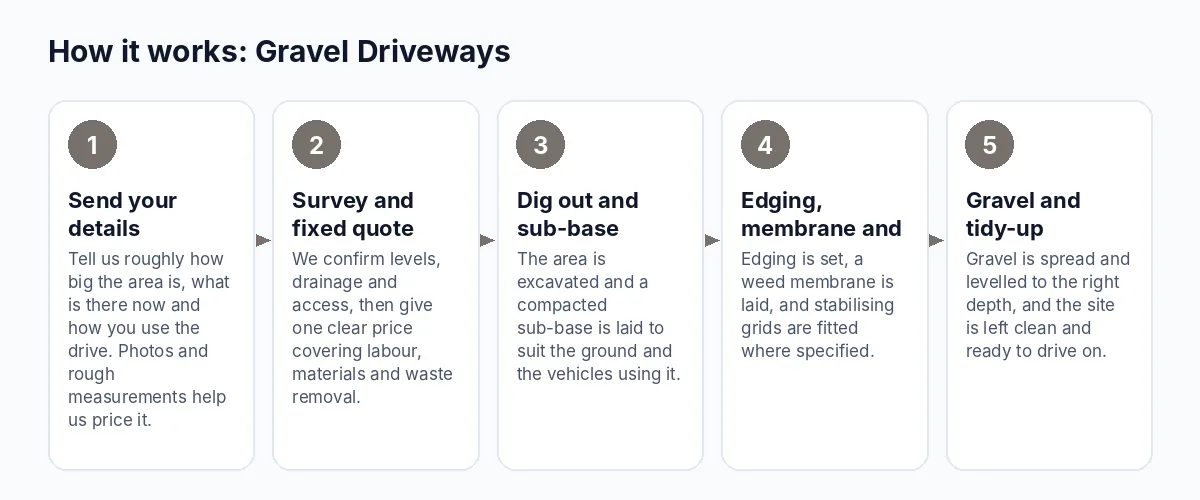
Most gravel driveway problems, such as ruts, puddles, sinking patches and weeds, come from a poor base rather than the gravel itself. A new gravel drive should start with excavation to firm ground, usually 150mm to 250mm below finished level, followed by a sub-base of crushed stone such as MOT Type 1 laid in layers and compacted with a plate compactor or roller. That base is what carries the weight of the car.
On top of the sub-base goes a permeable geotextile membrane to separate the stone from the soil and suppress weeds, then a solid edge to stop the gravel spreading into lawns and beds. The final layer is angular gravel, usually 10mm to 20mm, spread to around 40mm to 50mm. Laying it thinner exposes the base; laying it much deeper makes it hard to walk and drive on.
What is included
- Site survey to check levels, falls, drainage and access for machinery and grab lorries
- Excavation of soil, turf or old surfaces to the depth the ground needs
- Removal and disposal of excavated spoil
- MOT Type 1 or similar crushed-stone sub-base laid and compacted in layers
- Permeable geotextile weed membrane laid with overlapped joints
- Edging set on concrete along lawns, beds, paths and the boundary
- Angular driveway gravel spread and levelled to around 40mm to 50mm
- Final rake, compaction where specified and site tidy-up
Who it is for
- Front gardens being turned into off-street parking
- Period cottages and rural homes where gravel suits the setting
- Long or large drives where bound surfaces would be expensive
- Owners who want a permeable surface that normally avoids planning permission in England
- Landlords and developers who want a durable, low-cost finish
How much does it cost?
As a guide, a new gravel driveway in the UK usually costs £40 to £100 per square metre installed. Deep excavation, poor ground, long edging runs and premium decorative stone push prices towards the top of the range. See our full cost guide.